
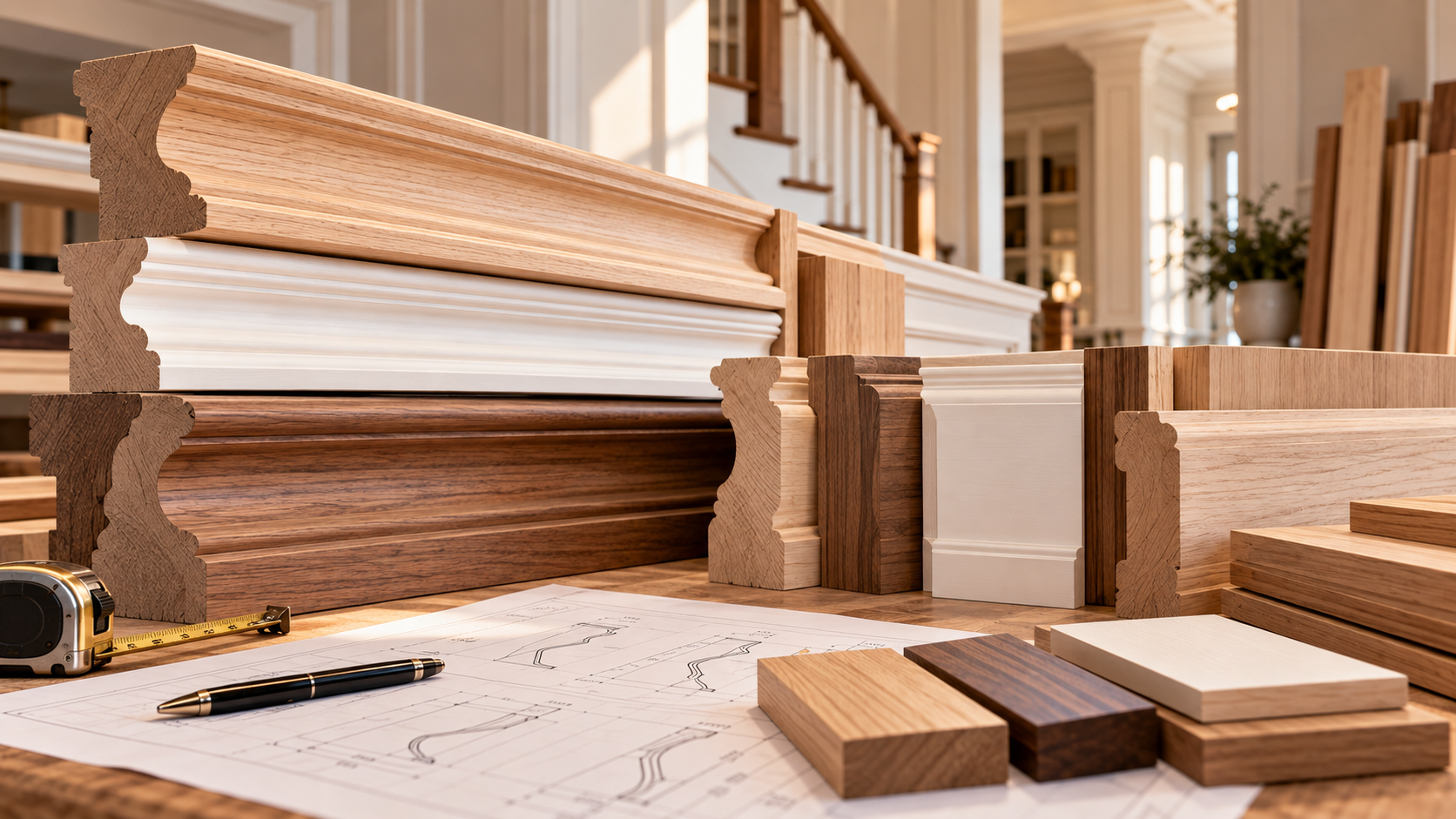
The right trim profile depends on your ceiling height, room proportions, architectural style, wood species, and whether the finished trim will be painted or stained. A well-chosen profile brings doors, windows, walls, and ceilings into balance; the wrong scale or level of detail can make an otherwise beautiful room feel busy or unfinished. For homeowners, builders, designers, and carpenters in the Carolinas, thoughtful planning makes Custom Trim Profiles
a practical way to achieve a cohesive result.
Start With Ceiling Height and Room Proportions
Trim should feel proportional to the space around it. In rooms with standard-height ceilings, simpler profiles and moderate widths usually create the cleanest look. Taller ceilings can support more substantial baseboard, wider casing, built-up crown molding, or a more detailed custom trim profile.
Consider the room as a whole rather than choosing each piece independently. A tall baseboard paired with very narrow door casing can look disconnected, while oversized crown molding may overwhelm a small room. Heritage Millworks can help produce coordinated linear profiles that give each element a consistent visual weight.
Match the Architectural Style of the Home
The best custom trim reflects the character of the home. Traditional homes often call for layered casing, decorative crown molding, chair rail, and profiles with curves, beads, or stepped details. Farmhouse, Craftsman, and contemporary interiors may lean toward cleaner lines, flatter faces, square edges, and restrained detail.
If you are renovating an older home, matching the existing Architectural Millwork
can preserve the home’s original character. We can match an existing profile from a physical sample or a drawing, helping you continue a historic detail into an addition, replacement area, or newly finished room.
Choose Each Trim Element for Its Job
Every trim component has a different purpose, but they should work together as a system:
- Door and window casing: Casing frames openings and creates a transition between the wall and jamb. Its width and detail should complement the doors, windows, and ceiling height.
- Baseboard: Baseboard protects the wall at floor level and establishes a visual foundation for the room. A simple baseboard can feel crisp and modern, while a taller or built-up profile can add formality.
- Chair rail: Chair rail divides wall surfaces and can define a dining room, hallway, stairway, or wainscoting layout. Its height should be planned around furniture, paneling, and overall wall proportion.
- Crown molding: Crown molding finishes the transition from wall to ceiling. The profile should be selected with both ceiling height and the room’s level of architectural detail in mind.
- S4S stock: Surfaced-four-sides lumber offers a versatile, clean starting point for simple casing, flat trim, blocking, and custom assemblies. It is especially useful when a straightforward linear detail is the right design choice.
Heritage Millworks manufactures standard linear profiles for baseboard, casing, chair rail, crown molding, and S4S stock. For coordinated options, explore our Crown Molding & Baseboard
capabilities.
Plan for Paint or Stain Before Selecting Wood
Your finish has a major impact on both material selection and profile design. Painted trim works well with many wood species and often allows the profile’s shadow lines and detail to stand out. It can be an excellent choice for crisp white casing, baseboard, or crown molding throughout a home.
Stained trim places more attention on grain, color, and joinery. When the trim will be stained, select a wood species that complements floors, cabinetry, doors, or other woodwork in the space. Simpler profiles can showcase beautiful grain, while more detailed profiles create light and shadow that may highlight the craftsmanship of the piece.
Use Samples and Drawings to Get the Details Right
A sample is often the easiest way to communicate an existing trim profile. If you have a short offcut from an older room, Heritage Millworks can use it as a reference to reproduce the shape. A dimensioned drawing, photo with measurements, or architectural detail can also provide the information needed to develop a matching profile.
Before production, consider the overall width, thickness, reveal, edge detail, and how the piece will connect to adjacent trim. This is particularly important when matching antique molding, planning custom casing around specialty doors, or coordinating trim with built-ins and cabinetry.
Understand the Manufacturing and Installation Roles
Heritage Millworks manufactures and delivers custom trim throughout the Carolinas. We work directly with homeowners, contractors, designers, architects, cabinet shops, and other trade partners to produce the millwork needed for the project.
Trim installation is completed by the client’s carpenter. Involving that carpenter early helps confirm field measurements, installation methods, transitions, and the quantities required. This division of work allows your installation professional to manage the onsite fit while Heritage Millworks focuses on producing consistent, high-quality custom molding and architectural millwork.
Coordinate Trim Across the Entire Project
Custom trim looks its best when it is planned as a family of profiles rather than a collection of unrelated pieces. Start with the primary visual elements—usually baseboard, casing, and crown molding—then choose chair rail, panel molding, and other linear profiles that share compatible proportions and details.
For a renovation, you may want an exact match in the most visible spaces and a simplified complementary profile in utility rooms or additions. For a new build, a coordinated package can help establish a distinct look from the front entry through the main living areas. Heritage Millworks can manufacture the custom trim components that bring that plan together.
FAQ
Can Heritage Millworks match my existing trim?
Yes. We can match an existing profile from a sample or drawing. Providing an offcut is ideal, but clear measurements, photos, and architectural details can also help identify the profile and dimensions needed.
What is the best crown molding size for my ceiling height?
There is no one-size-fits-all answer. Lower ceilings typically benefit from simpler, more modest crown molding, while taller ceilings can carry larger or built-up profiles. Room size, style, and nearby trim elements should also guide the decision.
Should custom trim be painted or stained?
Painted trim is versatile and highlights profile detail, while stained trim emphasizes wood grain and species selection. The best choice depends on the home’s style, existing finishes, and the appearance you want to achieve.
Does Heritage Millworks install custom trim?
We manufacture and deliver custom trim. Installation is handled by your carpenter, who can manage onsite measurements, fitting, fastening, and finish work.
What types of trim can be custom made?
We produce standard linear profiles, including door and window casing, baseboard, chair rail, crown molding, and S4S stock. We also provide custom millwork for projects that need a coordinated profile or an existing detail reproduced.
Whether you are matching an older profile or planning trim for a new home in North Carolina, South Carolina, or the surrounding Carolinas, Heritage Millworks can help you move from idea to finished material. Request a free quote to discuss your custom trim profile, quantities, and delivery needs.
Discover helpful insights, expert advice,
and practical information
on topics that matter to you.
Ready to Get Your Millwork into Production?
Submit a project inquiry through our contact form or call our shop directly.
Our team is available Monday through Friday, 7 AM to 3 PM, and responds to all inquiries within one business day.