
Custom Crown Molding and Baseboard Manufactured to Your Profile in North Carolina
Heritage Millworks machines crown molding and baseboard profiles to specification — your profile, your wood species, your scale — in our Troutman, NC facility. We manufacture and deliver to your job site. Your trim carpenter installs.
The crown molding and baseboard available at a lumberyard or home center typically come in a limited selection of standard profiles and fixed sizes. These products are designed for broad applications rather than a specific room, ceiling height, or architectural style.
Heritage Millworks manufactures crown molding and baseboard from the profile you specify, in the wood species the project calls for, and at a scale proportionally suited to your ceiling height and room dimensions. If the profile you need exists in a stock catalog, we can machine it. If it does not, we can machine it from your drawing, CAD file, or a physical sample. Our CNC process maintains consistent profile dimensions across an entire production run, ensuring every piece matches the approved specifications.
Crown Molding: Profile Styles and What Distinguishes Them
Crown molding is the most architecturally significant trim profile in a room because it defines the relationship between the wall and the ceiling — and because it is visible from across the room in a way that baseboard rarely is. Profile selection has a direct impact on the room's perceived style, scale, and finish quality.
Colonial Crown Profiles
Colonial crown profiles are characterized by a curved face — typically a combination of convex and concave curves — that spans from the wall to the ceiling with moderate projection. The most recognizable version is the traditional cove-and-ovolo profile: a concave curve at the base that transitions to a convex curve at the face. Colonial profiles are the most widely specified residential crown molding style in the southeastern US and work well in transitional and traditional interior architectures. Heritage Millworks machines colonial profiles from standard specs or to a custom variation that matches an existing profile in the home..
Craftsman and Arts-and-Crafts Profiles
Craftsman crown profiles are defined by flat planes and angular transitions rather than curves. The profile reads as a series of stepped flat surfaces — a wide flat face between a smaller step at the wall and a smaller step at the ceiling, with minimal or no curved elements. This profile style is correct for Craftsman bungalows, Arts-and-Crafts interiors, and contemporary spaces where a clean, rectilinear line is the design intent. Craftsman profiles are often run at a lower projection than colonial profiles, which suits the lower ceiling heights common in bungalow and cottage construction.
Modern and Minimal Profiles
A modern crown profile uses a single clean plane — often a simple cove or a square-edge transition — to address the wall-ceiling junction without architectural ornamentation. These profiles suit contemporary and minimalist interiors where the goal is a finished, intentional transition rather than a decorative statement. Heritage Millworks machines modern crown profiles in paint-grade and stain-grade species for projects where the trim is meant to recede into the architecture rather than call attention to itself.
Built-Up Crown Assemblies
A built-up crown assembly uses two or more separate profiles stacked or combined at the wall-ceiling junction to produce a more elaborate architectural cornice than any single molding profile can achieve. A common built-up assembly combines a large cove or ogee molding at the center with a flat bed molding below it and a smaller cap molding at the ceiling, producing a multi-member cornice with significant visual depth and projection.
Built-up assemblies are the standard approach in formal traditional interiors, high-end custom homes, and historic preservation work where a period-correct cornice detail is required. Each member of the assembly is a separately machined profile; Heritage Millworks produces the full set of profiles for a built-up assembly as a matched package so that the profiles are dimensionally coordinated and install together as designed.
Choosing the Right Crown Scale for Your Ceiling Height
Crown molding that is undersized for a room reads as an afterthought. Crown that is oversized for a ceiling height reads as heavy and disproportionate. Scale selection — the relationship between the profile's face width and projection and the ceiling height of the room — is the single most important decision in crown molding specification, and it is one Heritage Millworks works through with clients before any profile is machined.
The general guidelines for crown scale relative to ceiling height:
- Eight-foot ceilings: a profile face width of 3.5 to 4.5 inches is proportionally appropriate; wider profiles crowd the wall-ceiling junction at this height
- Nine-foot ceilings: a profile face width of 4.5 to 5.5 inches reads correctly; this is the most flexible ceiling height for profile selection
- Ten-foot and higher ceilings: profiles of 5.5 inches and above are appropriate, and built-up assemblies become a viable and often preferred option for adding visual weight and architectural character at greater height
Spring angle — the angle at which the molding sits between wall and ceiling — also affects how a profile reads at a given ceiling height. Heritage Millworks discusses spring angle alongside face width during the profile selection process for projects where both variables affect the correct specification.
These guidelines are starting points, not fixed rules. Room width, room function, the height of the door and window casings, and the presence of other architectural trim all affect what scale reads correctly in a specific space. Heritage Millworks works through these decisions with clients during the specification process so that the profile ordered is the profile the room calls for.
Baseboard: Profile Selection and Scale
Baseboard is the trim profile that runs at the base of interior walls, and it carries the same design logic as crown molding: the profile must be proportionally correct for the room, consistent in style with the other trim elements, and machined with enough dimensional precision that it installs cleanly against both the wall and the floor finish.
Basswood is a fine-grained, very light-colored hardwood with minimal natural scent and extremely low resin content. It is the preferred species for clients who are sensitive to wood scent in enclosed spaces — cedar's natural aroma, while pleasant to most users, is a consideration for some. Basswood is soft, smooth, and dimensionally stable in sauna environments. Its near-white color and fine grain give interiors a clean, understated appearance that works well in Scandinavian-influenced and contemporary sauna designs.
Basswood
Profile Style Coordination With Crown and Casing
Baseboard profile style should be coordinated with the crown molding and door casing profiles used in the same space. Traditional rooms with colonial crown benefit from a baseboard that uses the same curve vocabulary — a cove or ogee profile at the top edge that echoes the crown above. Craftsman rooms call for a flat-top baseboard with a simple cap molding at the top edge, consistent with the rectilinear character of the trim set. Modern interiors typically use a tall, flat baseboard with a square or pencil-round top edge — a profile that is clean and consistent with the minimal crown treatment in the same space.
Heritage Millworks can produce coordinated trim sets — baseboard, crown, and casing — machined as a matched package so that the profiles are stylistically consistent and dimensionally coordinated across all three elements.
Baseboard Height and Room Proportion
Baseboard height follows the same proportion logic as crown scale. A three-and-a-half to four-inch baseboard reads correctly in a room with eight-foot ceilings. Five-and-a-half to seven-inch baseboard is appropriate for rooms with nine- to ten-foot ceilings and adds visual weight to the base of the wall in spaces where the ceiling height calls for it. Taller baseboard — seven inches and above — is typical in formal rooms, historic homes, and custom builds where a pronounced base treatment is part of the architectural program.
Built-Up Baseboard Assemblies
A built-up baseboard assembly combines two or more profiles — typically a tall flat base board with a shaped cap molding at the top and a separate base shoe at the floor — to produce a more substantial base treatment than a single profile achieves. Built-up baseboard is common in period-correct traditional interiors and in custom homes where the base treatment is intended to anchor the room visually in proportion to the crown above. Heritage Millworks machines built-up baseboard as a coordinated set of profiles designed to work together in the assembly.
Heritage Millworks machines crown molding and baseboard in paint-grade and stain-grade species. The right choice depends on whether the finished trim will be painted or finished with a transparent stain or clear topcoat that leaves the wood grain visible.
Wood Species for Crown Molding and Baseboard
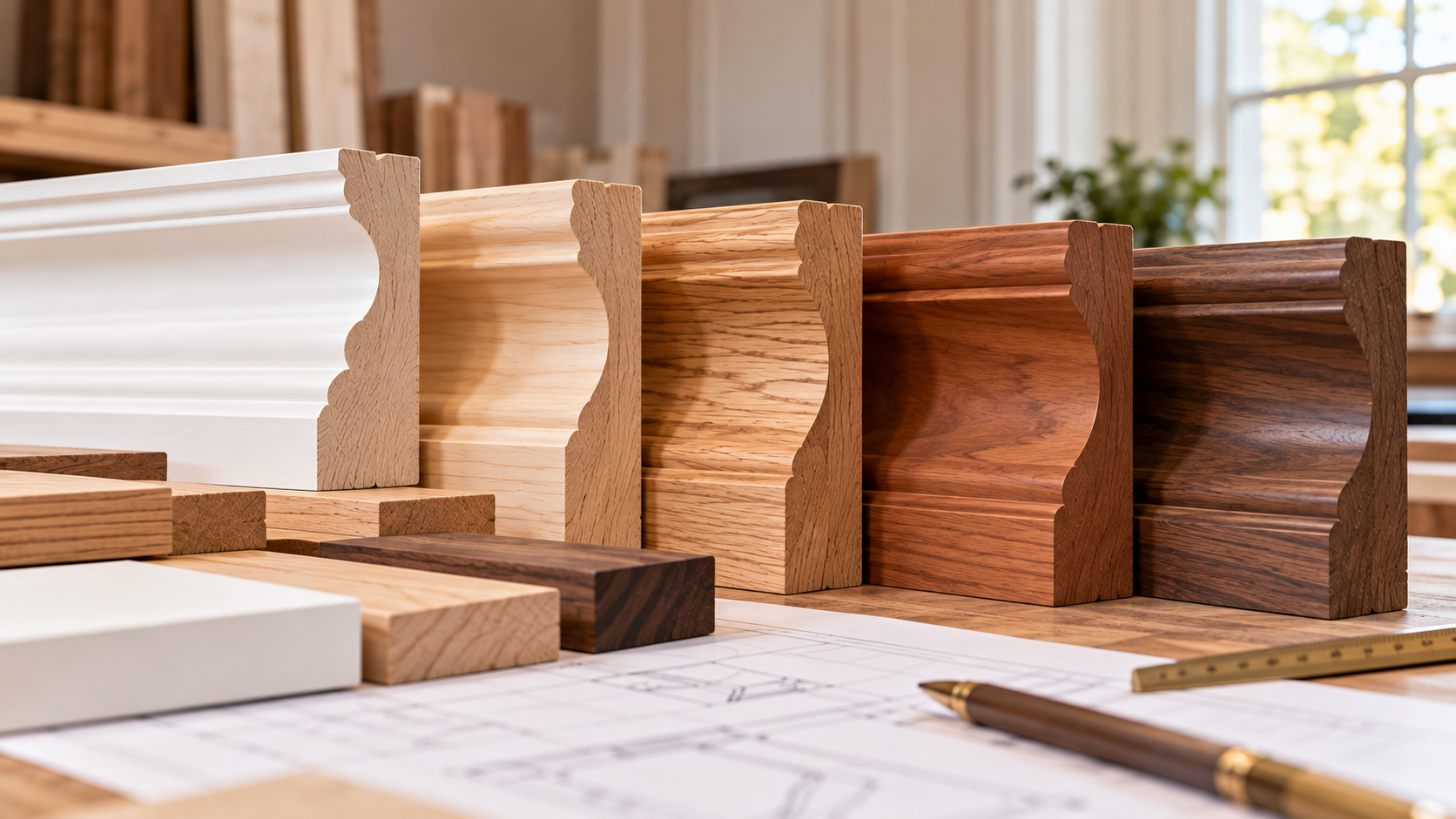
Heritage Millworks machines crown molding and baseboard in paint-grade and stain-grade species. The right choice depends on whether the finished trim will be painted or finished with a transparent stain or clear topcoat that leaves the wood grain visible.
Paint-Grade Species
Paint-grade millwork is machined from wood species selected for their smooth, consistent surfaces and ability to accept primer and paint evenly.
Heritage Millworks uses poplar, a stable, fine-grained hardwood that provides a smooth finish with minimal visible grain. Poplar machines cleanly into both standard and custom molding profiles, making it a practical choice for painted crown molding, baseboard, and other architectural millwork.
Stain-Grade Species
Stain-grade millwork is machined from species with visible grain character that a transparent finish is intended to display. The species selection should reflect the wood character that works with the room's existing or planned finish palette.
Red oak is the most widely used stain-grade trim species — consistent grain, good machinability, and broad availability in clear grades. Hard maple is a lighter, finer-grained option that suits contemporary interiors and finishes to a smooth, even surface. Cherry has a rich reddish-brown color and a fine grain that deepens with age and light exposure — a common specification for formal traditional interiors. Walnut is a dark, strongly grained hardwood that suits contemporary and transitional rooms where the trim is intended as a design statement. Alder is a light, fine-grained hardwood with moderate figure that finishes evenly and suits transitional interiors where a mid-range grain character is appropriate.
For Architects and Designers: A Regional Manufacturing Partner for Custom Millwork Specifications
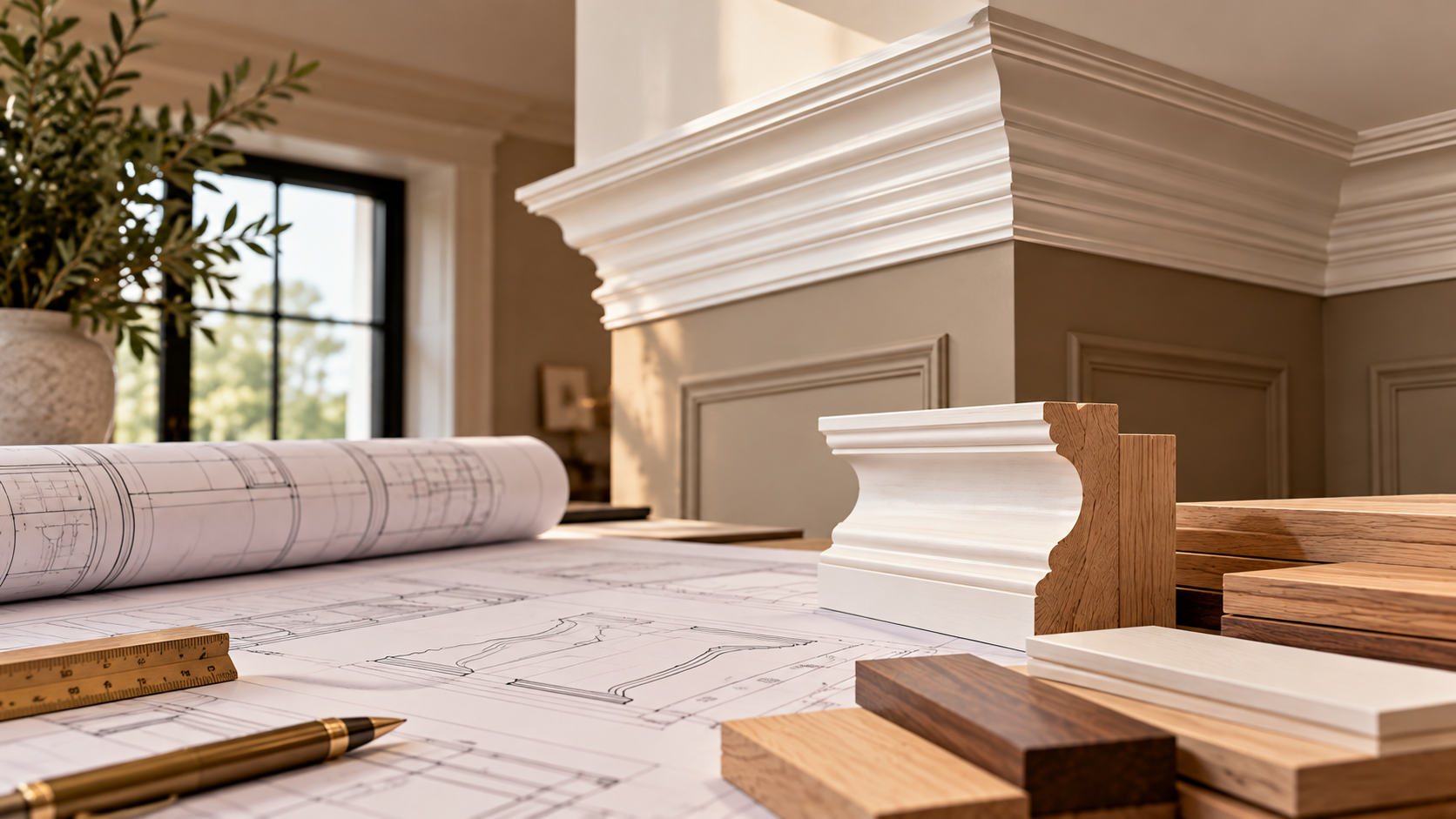
Architects and interior designers who specify custom millwork details need a manufacturing source that can produce from a drawing, hold the profile to specification across a full project run, and deliver on a timeline that works within a project schedule.
Heritage Millworks works with architects and designers directly on custom profile specifications. When a design calls for a specific cornice detail, a custom casing profile, or a trim set that is not available from stock suppliers, Heritage Millworks machines it from the specification provided — drawing, CAD file, or physical sample — and produces the full project quantity with CNC consistency from the first piece to the last.
For architects managing multiple projects, Heritage Millworks can store profile programs from previous specifications for reuse across future projects, so that a custom detail developed for one client does not require a new specification submission to produce again.
Trade clients seeking a fuller scope of collaboration — including wine room fabrication, sauna manufacturing, and coordinated millwork production across design projects — can learn more about how Heritage Millworks works with the professional design community on our
trade and design partners page.
How to Order Custom Crown Molding or Baseboard from Heritage Millworks
Submit a Profile Specification
Use the contact form to describe your project. Include the profile type, any drawings or samples you have, the wood species, the quantity in linear feet, and your required delivery timeline. If you have an existing profile you need matched — from a physical sample or a profile drawing — include that in your submission.
Profile Review and Quote
Our team reviews your submission, assesses machinability, and provides a quote covering material, machining, and estimated lead time. For custom profiles, we may request a test piece approval before running the full quantity.
Production and Delivery
Once the quote is approved, your profile goes into production. CNC machining ensures every linear foot is produced to the same specification. Finished profiles are packaged for transit and delivered to your job site or facility. Heritage Millworks delivers; your trim carpenter installs.
Questions About Custom Crown Molding and Baseboard Manufacturing
What makes a custom crown molding manufacturer different from a lumberyard stock supplier?
A lumberyard stocks profiles in the patterns and sizes a manufacturer chose to produce for broad distribution. Heritage Millworks machines profiles to your specification — the pattern, the scale, the wood species, and the quantity your project calls for. If the profile you need exists in a stock catalog, we can machine it. If it does not, we machine it from your drawing or sample. The output is a profile that is correct for your project, not the closest available approximation from a catalog.
Can you match an existing crown molding profile in an older home?
Yes. Profile matching from a physical sample is a standard Heritage Millworks service. Submit a sample — a clean, undamaged piece of the existing profile at least 12 inches long — and our team will assess the profile geometry, confirm machinability, and provide a quote. This service is commonly used for renovation and addition work where new trim needs to match existing installed profiles precisely.
Does Heritage Millworks install crown molding and baseboard?
No. Heritage Millworks manufactures trim profiles and delivers them to your job site or facility. Installation is performed by your trim carpenter or finish contractor. If you need a referral to a regional installer, we can suggest trade contacts in our network.
What is a built-up crown molding assembly and when does it make sense?
A built-up crown assembly uses two or more separately machined profiles combined at the wall-ceiling junction to produce a more elaborate cornice than a single molding achieves. It makes sense in formal traditional rooms, high-ceiling spaces where a single profile lacks visual weight, and historic preservation work where a period-correct multi-member cornice is architecturally appropriate. Heritage Millworks machines the full set of profiles for a built-up assembly as a coordinated package.
How do I choose the right crown molding scale for my ceiling height?
As a starting point: eight-foot ceilings suit a profile face width of 3.5 to 4.5 inches; nine-foot ceilings suit 4.5 to 5.5 inches; ten-foot and higher ceilings support 5.5 inches and above, where built-up assemblies also become appropriate. Room width, door and window casing height, and the presence of other trim elements all affect what reads correctly in a specific space. Heritage Millworks works through scale and proportion with clients during the specification process — so that the profile ordered is the right profile for the room, not a guess.
What is the minimum order quantity for custom crown molding?
There is no minimum order quantity that makes a single custom profile impractical to produce. Heritage Millworks machines to project quantity — whether that is 50 linear feet for a single room or several thousand feet for a full custom home run. Submit a project inquiry with your quantity and timeline and our team will provide a quote accordingly.
Ready to Put Your Trim Profile into Production?
Submit a project inquiry through our contact form with your profile description, species preference, quantity, and timeline. Our team responds within one business day.